Challenge
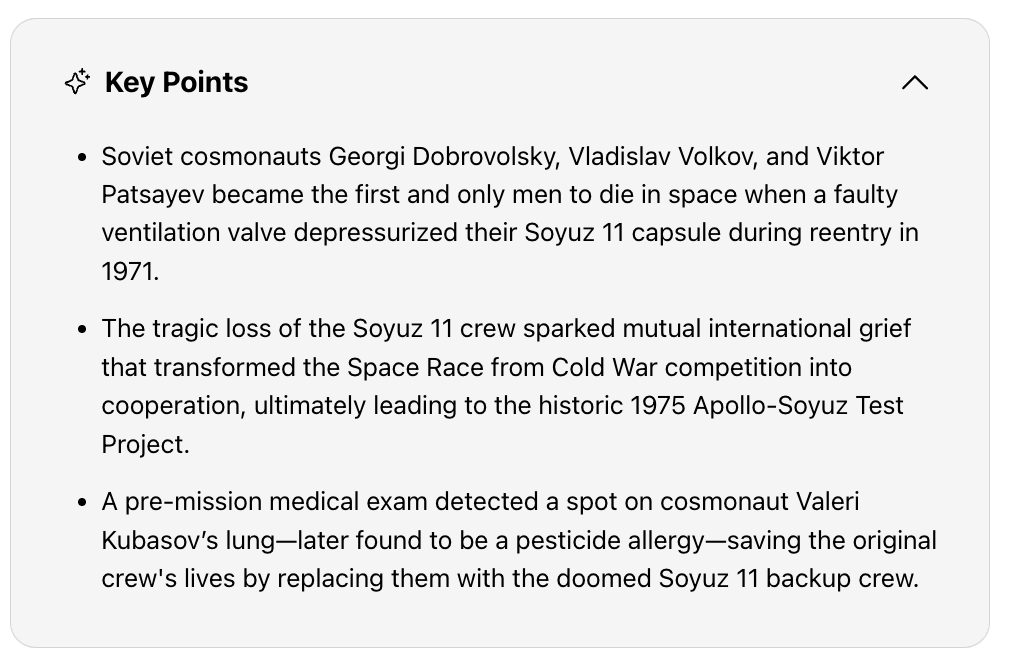
Editors at several Hearst brands had already figured something out: articles with manually written bullet-point summaries at their top performed better. Readers who understood where a story was headed scrolled further, spent more time on the page, and engaged more deeply with the content. The problem was that writing these summaries by hand was time-consuming and inconsistent across sections.
At the same time, an opportunity was emerging. AI language models were becoming capable enough to generate credible first drafts of article summaries — but newsrooms were deeply divided about whether and how to use them. Some brands were already using AI tools informally; others wanted nothing to do with it. And Hearst's legal team had clear requirements about disclosure whenever AI-generated content appeared in front of readers.
The challenge was to build a system that could scale the editorial benefit across 30+ U.S. magazine websites — without forcing any newsroom into an AI workflow it didn't trust.
My Role
As Product Manager, I led the initiative from discovery through multi-brand rollout:
- Directed a cross-functional team of 8 engineers and 1 product designer
- Conducted discovery interviews with editorial teams at partner brands to understand existing workflows and AI attitudes
- Worked with Hearst's legal team on disclosure language and compliance requirements
- Designed the feature's governance model: opt-in AI, mandatory editorial review, configurable at the brand level
- Managed a phased rollout across 30+ brands
Approach
1. Start With the Signal, Not the Technology
The initial insight came from existing data: news articles where editors had manually added bullet-point summaries were already seeing meaningfully better engagement. Rather than starting with “how do we deploy AI?,” we started with “why does this format work, and how do we make it available to every brand?”
That framing changed how we built the feature. The AI component was an accelerant, not the point. The point was giving every editor the ability to add context-setting summaries to their stories — whether they wanted AI help or not.
2. Build for the Skeptics, Not Just the Early Adopters
Discovery interviews revealed that brands had profoundly different relationships with AI. Some were already using it heavily in their workflows. Others were actively hostile to it — and had good reasons to be, including reader trust concerns, hallucination risks on technical content, and preserving their editorial voice.
We built the product around that reality. The non-AI version launched first, giving skeptical newsrooms time to get comfortable with the format before the AI layer was introduced. When we did add AI generation, we made it opt-in at both the brand level and the individual story level — a brand could disable AI entirely with a feature flag, and even within AI-enabled brands, writers could choose not to generate a draft. No one was forced into a workflow they didn't trust.
3. Solve the Legal Problem as a Product Problem
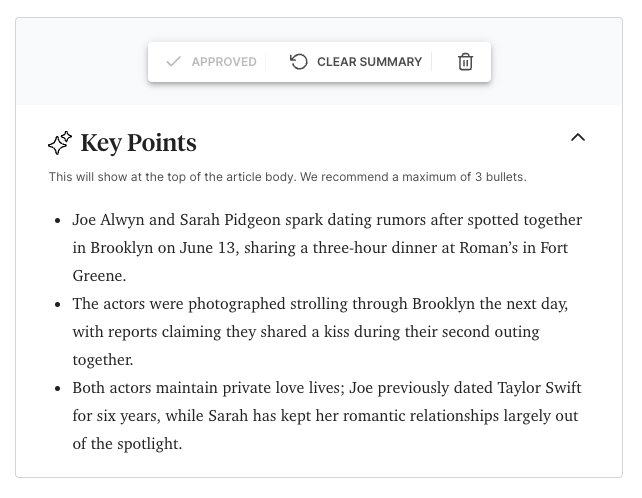
Working with Hearst's legal team, we established that AI-generated content required both disclosure and mandatory editorial review before publication. We built this directly into the product: an automatic AI disclaimer appeared on any content where the AI draft button had been clicked, and the system required explicit editorial approval before a story could publish. Editors couldn't forget the approval step; the workflow enforced it.
Later, we worked with legal to move the disclaimer from the article level to a broader AI policy statement in each site's footer, which reduced friction for editors who were uncomfortable with the per-article disclosure while maintaining full transparency for readers.
4. Make It Configurable Without Creating Chaos
Each brand needed to be able to customize the feature to fit its voice: the heading (“Key Points,” “What You'll Learn,” “The Rundown”), the disclaimer language, the AI model and prompt, even whether to use AI at all. We built all of this into a brand-level configuration layer so each property could tailor the experience without requiring engineering work.
We also tested multiple AI endpoints before landing on a default model and prompt. The configuration system allowed any brand to experiment with their own preferred model and prompting approach.
Results
- Saved editors 5–10 minutes per article on summary creation
- 80+ editorial hours saved per week across the 30+ U.S. magazine websites in scope
- 11 brands successfully launched in the first rollout wave
- AI toggle adoption varied as expected — some brands embraced it fully, others chose the non-AI version, which itself validated the decision to make both options available
- Increased SEO and GEO signaling from server-rendered summaries visible to search crawlers and AI discovery platforms
- Engagement hypothesis established: editorial teams at launch brands had already observed that articles with manually written summaries performed better — readers who understood where a story was headed scrolled further and engaged more deeply. Standardizing and scaling that practice across 30+ U.S. magazine websites is the bet this feature makes; A/B testing to confirm the causal relationship is the next phase.