Challenge
Fire officials called for a record-setting wildfire season in Southern California in 2013, and our newsroom at KPCC/LAist was about to cover a lot of fires. The problem was that covering each one meant the same manual grind: producers and reporters refreshing a handful of government websites and calling fire-department press officers to gather the same predictable data points — acres burned, containment, location, evacuation orders, air quality — for every new fire, over and over.
That repetitive work crowded out the reporting only journalists could do: talking to witnesses, verifying conditions on the ground, and telling the human story. It also left nothing behind — each fire's data vanished into individual articles, with no shared record and no way to compare one fire, or one season, to another.
The question I posed to the team: could we automate the routine, structured data of a wildfire so our people could focus on the parts that actually needed a human — and package it so both radio and news editorial teams could use it, and any newsroom could embed it?
My Role
I originated and led Fire Tracker as a product. The build itself was the work of KPCC's Chris Keller, who wrote the Django application and the data scrapers, and the interface and information design were Jon White's. Bryan Ricker handled the server infrastructure. My contribution was the product and editorial thinking around it: keeping the project moving, and building support and a process for its use in the newsroom across both radio and digital teams:
- Framed the core problem as a workflow and product opportunity, not just another story to cover
- Worked out which wildfire data agencies reliably published, and how it mapped to what producers and reporters actually needed day to day
- Defined the two-audience model — a public dashboard and an embeddable "fire card" — that shaped what got built
- Acted as project manager across development, design, and infrastructure, and made sure the tool fit the newsroom's real routines rather than adding to them
Approach
1. Reframe Coverage as a Data Problem
Every wildfire shares a set of predictable elements that federal, state, and local agencies collect as a matter of course. We recognized that much of that data could be gathered automatically — and that no amount of automation could replace a journalist's judgment about what actually mattered. That split became the organizing principle: let the machine handle the rote data, and free journalists and producers for the human element.
2. Map the Data to Real Needs
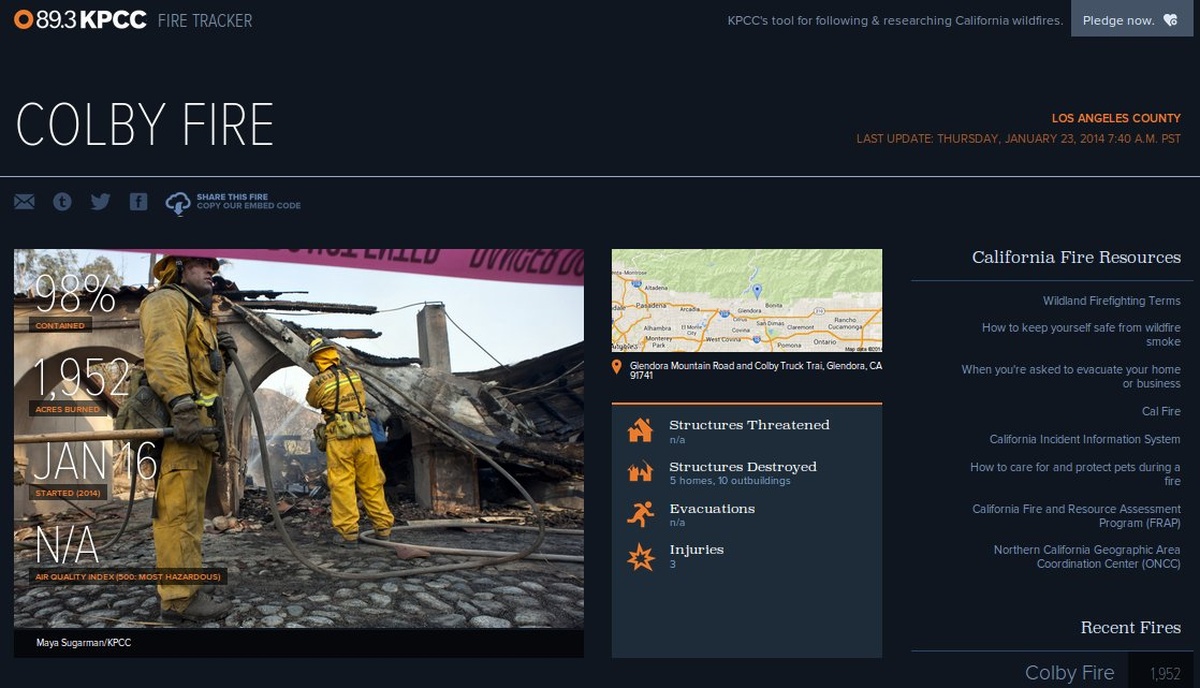
CalFire and other agencies published a rich, if messy, stream of active and archival fire data. Fire Tracker queried those sources several times a day, decided whether each result was a new fire or an update to an existing one, and stored it as a structured, historical record. Because breaking news moves faster than any scraper, we built in a manual "lock" so a producer could freeze a fire's record during a fast-moving event and keep automation from overwriting hand-checked information. They could then set the incident to automate once the updates became less frequent.
3. Design for Two Audiences
Fire Tracker shipped as two connected things: a standalone public dashboard where anyone could get up-to-the-minute fire size, location, containment, air quality, and evacuation information; and an embeddable "fire card" that LAist producers — or any other outlet — could drop into a story. The card got producers out of the business of refreshing government sites and chasing press officers, and let them spend that time on witnesses and the bigger picture instead.
4. Ship an MVP, Then Keep Learning
We took a "demos not memos" approach — a working prototype turned loose ideas into a real product decision, and we launched a minimum viable version in late July 2013 rather than waiting to design the perfect system. Real fires then taught us what to build next.
5. Prove the Pattern Generalizes
The underlying idea — strip the scrape-able, structured data out of a recurring story and hand it to the audience and producers in real time, so people can focus on advancing the story — turned out to generalize well beyond wildfires. The same model powered a companion Earthquake Tracker, and it proved itself in exactly the moment that matters: when a magnitude-6.0 earthquake struck Napa early one Sunday in 2014, injuring roughly 120 people, a producer on shift used the tracker live to pinpoint the epicenter and update the story through the day with eyewitness accounts gathered from reporters and social media.
Results
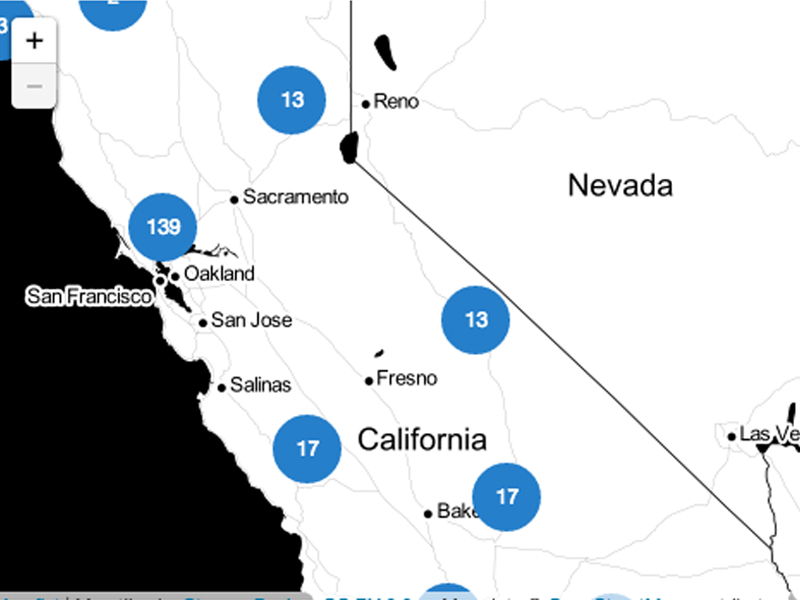
- 500k+ pageviews in the first months after the July 2013 launch
- During the Rim Fire, the embeddable fire card was among the top referrers to LAist's site — behind only search, Facebook, and Twitter
- Fire card embedded and republished by national and regional outlets including NPR, TIME, and the New York Times
- Recognized with a Society of News Design award
- Established a reusable model that carried over to a companion Earthquake Tracker — used live during the magnitude-6.0 Napa earthquake in 2014