Challenge
Every election, California's largest public radio stations covered many of the same statewide races and ballot measures separately — duplicating reporting, production, and cost, while none had the resources to cover the nation's biggest, most complex electorate as deeply as it deserved. Inside my own newsroom, we also rebuilt the same reader-facing election tools cycle after cycle.
For 2016 — a presidential year with an open U.S. Senate seat succeeding Barbara Boxer and a crowded, high-stakes ballot including recreational-marijuana legalization — four of the state's biggest stations decided to pool their coverage into the California Counts Collaborative: KPCC in Los Angeles, KQED in San Francisco, KPBS in San Diego, and Capital Public Radio in Sacramento.
That raised two hard problems that had nothing to do with reporting: how do four independent, sometimes-competing newsrooms actually share content across different systems — and how do they agree on the rules for using and crediting one another's work?
My Role
My title stayed the same — Senior Digital Editor at KPCC/LAist — and California Counts became one responsibility layered on top of my day-to-day job overseeing the newsroom's digital coverage. I want to be precise about scope: I did not coordinate the collaborative's day-to-day coverage (a social media editor on my team led that), and the partnership itself was convened by station leadership. What I owned was the plumbing and the tools:
- Built the mechanism and standards for sharing content across the four stations — the technical infrastructure that let each newsroom access shared digital and audio content
- Led the inter-station discussion that produced the publishing protocol and a memorandum of understanding for crediting reporting
- Owned the "MyBallot" personalized voter guide — its creation at KPCC and its distribution to partner stations
- For MyBallot, reached out to candidates for their information, gathered shape files for California's many district maps, and oversaw an intern supporting the work
- Carried all of this while continuing to edit and oversee the newsroom's digital coverage, in and out of election season
- Drew on similar election-tool efforts I had run in prior cycles
Approach
1. Treat Sharing as Infrastructure, Not a Favor
The point wasn't to email each other files. I built a mechanism and a set of standards so any partner station could reliably pull shared digital and audio content into its own workflow, in predictable formats — turning content-sharing from a series of one-off asks into dependable infrastructure the collaborative could lean on all year.
2. Write the Rules Before the Rush
Independent newsrooms that normally compete don't share freely unless they trust how their work will be used and credited. So we negotiated that up front: a publishing protocol and a memorandum of understanding spelling out how shared content could run and how each newsroom's reporting would be attributed. Settling the rules in advance meant election night was about the election, not a rights dispute.
3. Build MyBallot Once, Share It Everywhere
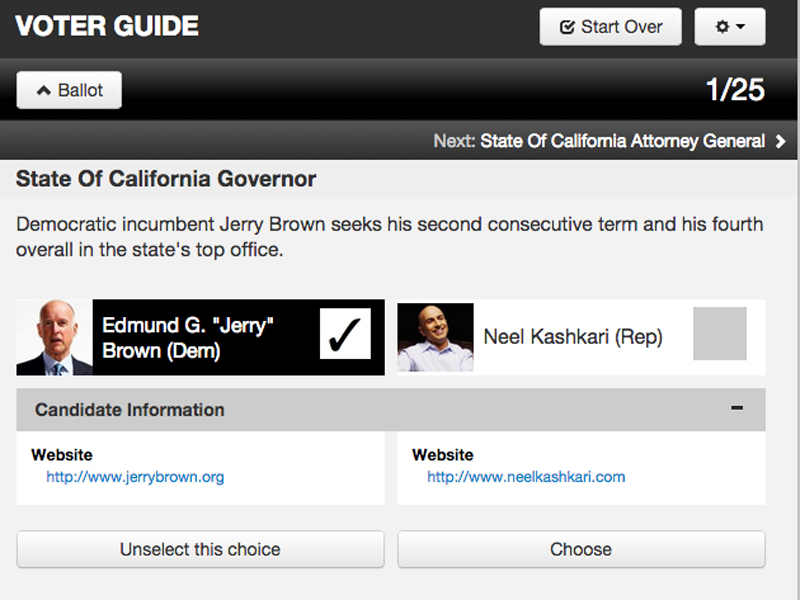
MyBallot was a personalized voter guide: a reader could enter or geolocate their address and see everything on their specific ballot — from the U.S. Senate race down to community college board — drawn from state, county, and local election data. I solicited responses from candidates up and down the ballot, assembled the shape files needed to match addresses to California's tangle of districts, and built the tool so partner stations could run their own version, tailored to their audience.
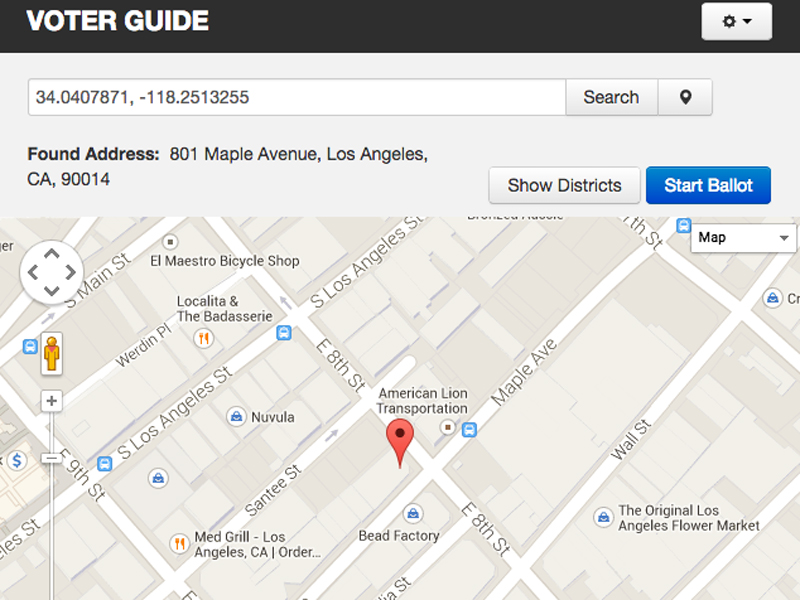
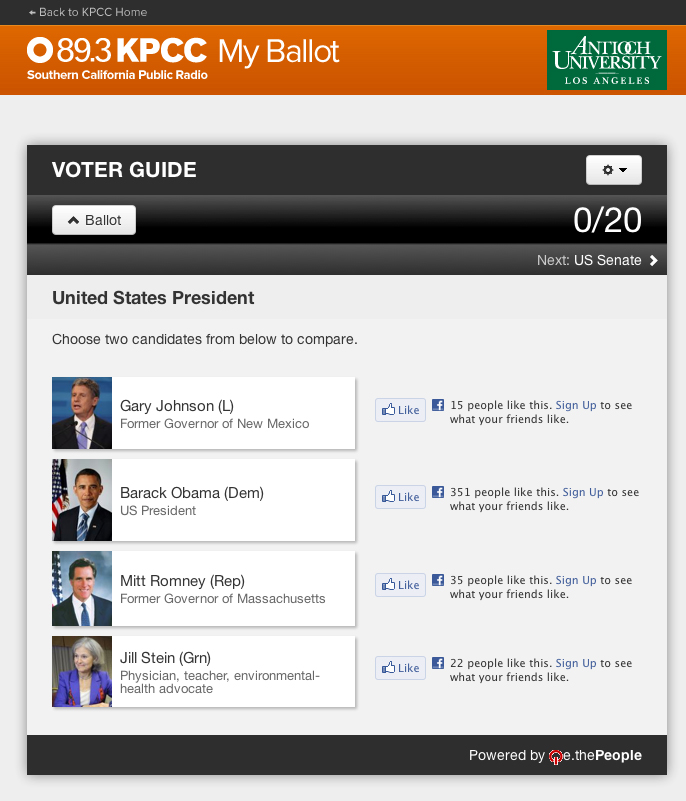
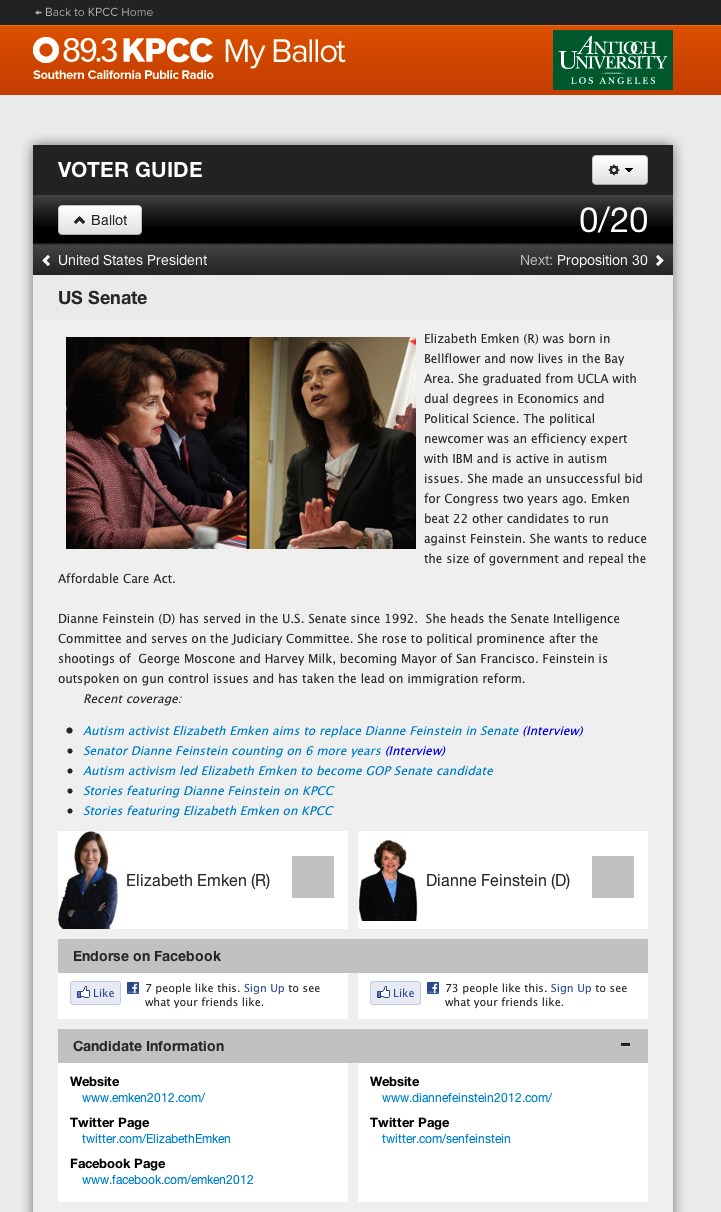
The result: a printed, emailed, or texted rundown of their choices to fill out their ballot at the polling place or at home. Source: KPCC.
4. Make It Repeatable
Because I'd built similar tooling in previous election cycles, I designed both the sharing mechanism and the guide to be reused rather than rebuilt from scratch each time — the same infrastructure instinct, applied to a recurring event.
Results
- A content-sharing mechanism and crediting MOU adopted across four of California's largest public radio newsrooms — KPCC, KQED, KPBS, and Capital Public Radio
- Underpinned a yearlong, statewide 2016 collaboration backed by a $135,000 James Irvine Foundation grant, drawing on up to ~30 reporters and editors
- A "MyBallot" personalized voter guide shipped at KPCC and shared to partner stations, each tailored to its own audience
- Supported coverage spanning the U.S. Senate race, statewide ballot measures, a town-hall series, the #CAcounts and #whatsmyissue campaigns, and a CALSPEAKS (Sacramento State) voter poll
- Reused a tooling-and-sharing pattern I'd developed in prior cycles, cutting the rebuild work required each election
Note: reach and traffic figures from 2016 are no longer available to me; the metrics above are limited to what can be documented publicly.